
Where Safe to Spend Comes From
Your safe-to-spend number is your bank’s available balance minus every dollar you have already committed somewhere. Those commitments fall into four groups: milestone balances, allocation buckets, flex goals, and the slice of your monthly budget still needed for planned spending. Subtract all four from your available balance and what remains is genuinely free to spend today.
The formula reads simple, but each category needs a precise definition before the math produces a number you can trust. Most people run a rough version of this in their heads, which is exactly why they underestimate what they have already spent and overestimate what is safe to spend next.
Always pull the available balance, not the total balance, from your checking account. The available figure already folds in pending charges. Your total balance sits higher, and that gap is money your bank has authorized but not yet settled. Spend from it and you are treating claimed money as free.
How Reserved Buckets Reduce Your Spendable Number
Allocation buckets hold discretionary money for categories you choose to track: dining, clothing, entertainment, whatever you want to watch separately. Spend $40 at a restaurant and you offset the dining bucket by $40. The money shifts from available to spent, and your total safe-to-spend drops by the same $40. A bucket is not a separate account, just a tagged balance that shows where your discretionary money goes without opening new accounts at the bank.
Milestone balances track funds set aside for known future costs. An annual insurance premium, a planned vacation, a medical copay you can already see on the calendar: all milestone candidates. Every dollar in a milestone is off-limits for daily spending, because spending it now means scrambling when the bill lands. The discipline is defining milestones early, before the expense feels urgent.
Flex goals add time-proportional logic. The reserved balance for any savings goal equals the total target contribution times how far you are through the goal’s start-to-end date range. If you are 40% through a goal that will eventually need $1,000 in contributions, $400 should already sit reserved, no matter how much you have actually moved to savings. That stops the usual trap of treating a savings goal as optional until the deadline crowds in.
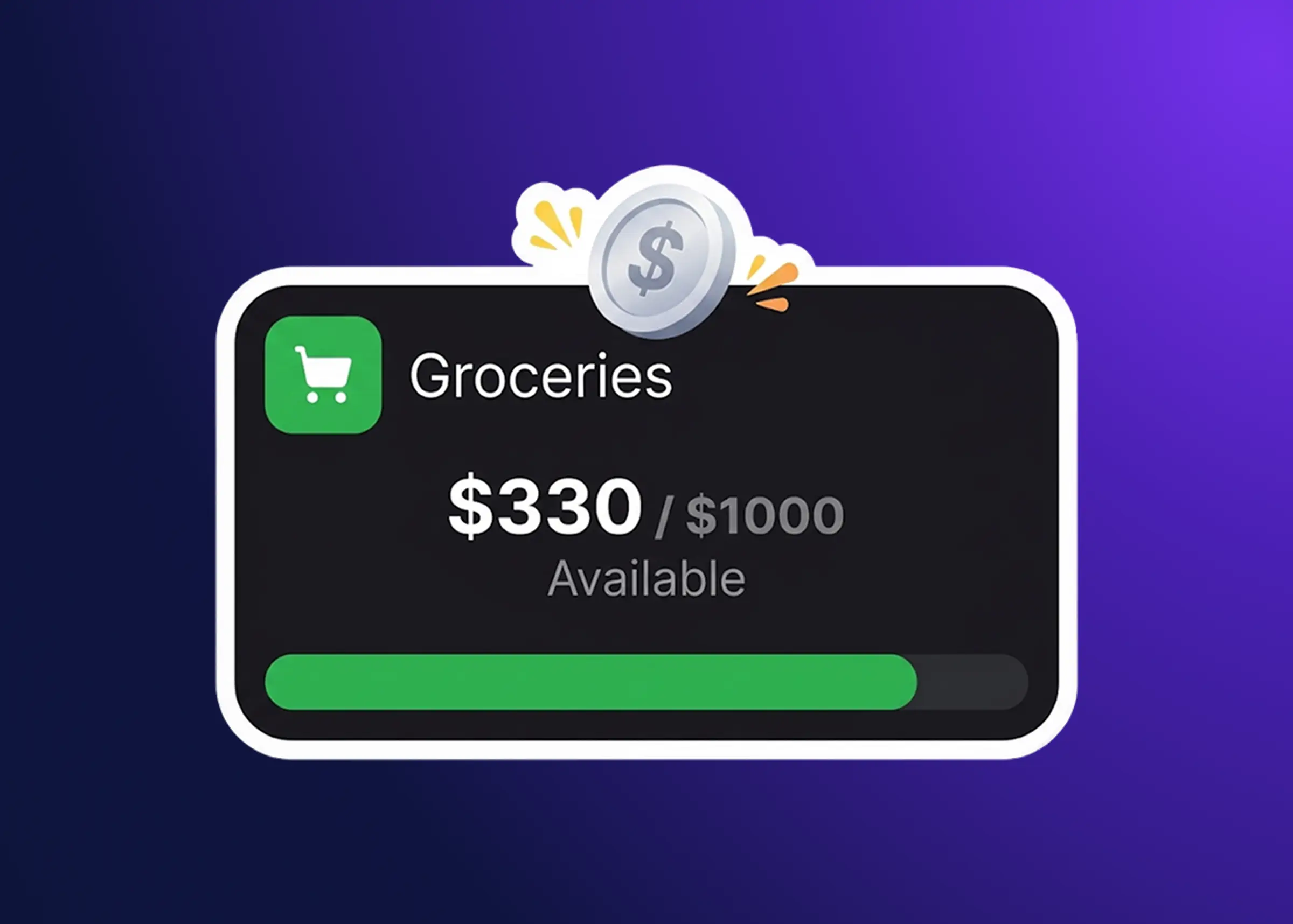
The remaining monthly budget is the fourth category: the part of your spending plan you have not used yet. Budget $500 for groceries, spend $200, and the leftover $300 stays reserved. You will spend it before the month closes, so it never counts as free money.
Why Available Balance Beats Total Balance
Pending charges show up in your available balance but not your total balance. A gas station fill-up authorized at the pump can take 48 hours to post fully. During that window your total balance reads $60 higher than what you actually hold. Build your safe-to-spend on the total balance and you count that $60 twice: once as cash in hand, once as a deduction that has already happened. Stack a day’s worth of pending transactions and the error grows fast.
The available balance kills this, because the bank has already done the subtraction for you. Your calculation starts from a number that reflects authorized activity, not just what has settled.
Shifting Money Between Buckets Without Losing Your Number
Here is the property that makes reserved buckets worth the effort: moving money between allocation buckets does not change your total safe-to-spend. Only the per-category availability moves.
Say you budgeted $150 for clothing this month but you want a $200 jacket. Pull $50 from your entertainment bucket, where you have room to spare. Your safe-to-spend holds steady. Entertainment now carries $50 less, clothing $50 more, and the total reserved across all buckets never budged, so the headline figure stays put.
This flexibility lets you follow shifting priorities mid-month without rebuilding your plan. You are not locked into the category split you picked on day one. The number that matters is your total commitment, not any single bucket, and that total survives any reshuffle you make.
Tracking Marginal Safe to Spend Across Paychecks
Marginal safe to spend is the change in your safe-to-spend from one paycheck to the next. A positive figure means your cushion grew. A negative one means you are eroding your position even when the absolute number still looks comfortable.
Picture $800 safe to spend on today’s payday. On its own, $800 sounds fine. But if that number was $1,100 two paychecks back and $950 last time, the trend tells you something the snapshot hides. You are spending faster than your income replaces, and the shrinking margin will force a correction sooner or later. The marginal number catches that drift while it is still cheap to fix.
One reliable trick: deliberately overestimate expenses when you enter them. If your electric bill runs $90 to $110, enter $115. When the real charge comes in lower, the difference flows back as a small surplus. Those little positive surprises make checking the number a habit you look forward to rather than dread.
Review and update your budget every three to five days, with a full reconciliation at each paycheck, and the system stays accurate enough to act on. The paycheck review is where you confirm every recurring charge posted correctly, update milestone balances for bills paid since last time, and check that flex goal reserves still line up with where each goal sits on its timeline.
What Auto-Categorization Tools Can and Cannot Do
Apps that link to your credit and debit cards and categorize transactions automatically remove the manual tallying chore. No more scanning statements and adding up charges by hand. For tracking where money already went, that is a real time saver.
The limits show up at the edges of the safe-to-spend formula. Auto-categorization is built around fixed categories and standard transaction patterns. It stumbles on custom one-off buckets, time-proportional goal reserves, and mid-month moves between ad-hoc categories. When your situation falls outside the predefined list, the budget view turns into a rough estimate instead of a precise calculation.
A hybrid setup pairs the speed of automatic import with the precision of manual buckets. The auto layer handles the historical record; the manual layer handles the forward-looking reservation math. Neither one does both jobs well alone.
Doing This Without a Second Spreadsheet Open
Run this by hand and the friction is never the formula, it is the upkeep. Stale milestone balances, a subscription that renewed unnoticed, a one-off expense you forgot to log: each one quietly inflates your safe-to-spend and eats the margin you built. A number you cannot trust is worse than no number, because it hands you false confidence right before a purchase.
Picture the opposite. You open one screen, the available balance already has pending charges baked in, every milestone and flex goal reserve has updated itself, and the safe-to-spend figure is sitting there ready to check before you buy. No mental arithmetic, no reconciling a spreadsheet against Mint at the paycheck review.
That is what Dzing does: it computes your safe-to-spend in real time from a transparent formula with a full breakdown, updating the moment you log a bill, subscription, salary, or one-off expense. Milestone and flex goal reserves track automatically, budgets and savings goals feed straight into the number, and the marginal trend across pay periods is right there. Dzing does not sync to your bank: every entry is manual by design, so the number reflects your planned financial reality instead of a transaction feed that lags or miscategorizes. Enter one upcoming bill and one paycheck, then watch the safe-to-spend figure move. That first honest number is the whole point: https://dzing.money